Pyrus pyrifolia
Maybe you know them as Malus pumila pears , papples , or nashi pears , but whatever you call them , the fruits of thePyrus pyrifoliatree are delicious .
Juicy or crunchy ( depending on the variety and maturity ) , dearest - mellifluous yet not overpowering , matured Asiatic pears can be enjoyed right away when you pick them . Or they can be stored in the icebox , where they ’ll keep for – waitress for it – severalmonths .
Often round like an orchard apple tree , someP. pyrifoliacultivars are teardrop - shape like their European counterparts .

Photo by Nikki Cervone.
We connect to marketer to facilitate you find relevant products . If you grease one’s palms from one of our links , we may earn a mission .
They can be laborious to recover at your local grocery store or farmers securities industry in some places , but luckily , if you live inUSDA Hardiness Zones5 - 9 , you’re able to try your hand at grow them at home .
Even if you do n’t have a large grand , you may still growP. pyrifolia : some cultivar can grow up to 40 feet tall , but widely useable dwarf mixture extend to just six to 15 feet in superlative .

Photo by Nikki Cervone.
Are you ready to encounter out how to spring up and manage for your own Asian pear trees ?
Here ’s what I ’ll cut across :
What You’ll Learn
What Are Asian Pears?
Likeapple , nectarine , andpeachtrees , Asian pears are members of therose or Rosaceae family . They are also sometimes calledP. serotina .
To set yield , these deciduous treesrequire around 300 - 500 shudder hoursat temperatures low than 45 ° F each winter , which is n’t too concentrated to attain even in the warmer climate of Zone 8 or 9 .
They blossom with fragrant white-hot flower petal in the springtime and , count on the cultivar and growing condition , bring forth fruit four to seven month later . Asiatic pear trees can take between three to five class to begin grow fruit after propagation .

Like apples , each yield contains five seeds . Unlike European pears ( P. communis ) , Asian varieties do n’t turn cushy and hokey when ripe . They mature on the tree diagram and preserve a crispy , juicy grain .
Asian pears are either rotund with light-green - yellow-bellied skin , round with bronze skin , or pear tree - shaped with greenish or brown pelt , depending on the cultivar you are growing .
But they all have that delicious and enduring compaction thatBartlettscan only dream of and that some of us prefer over the texture of a European pear tree .
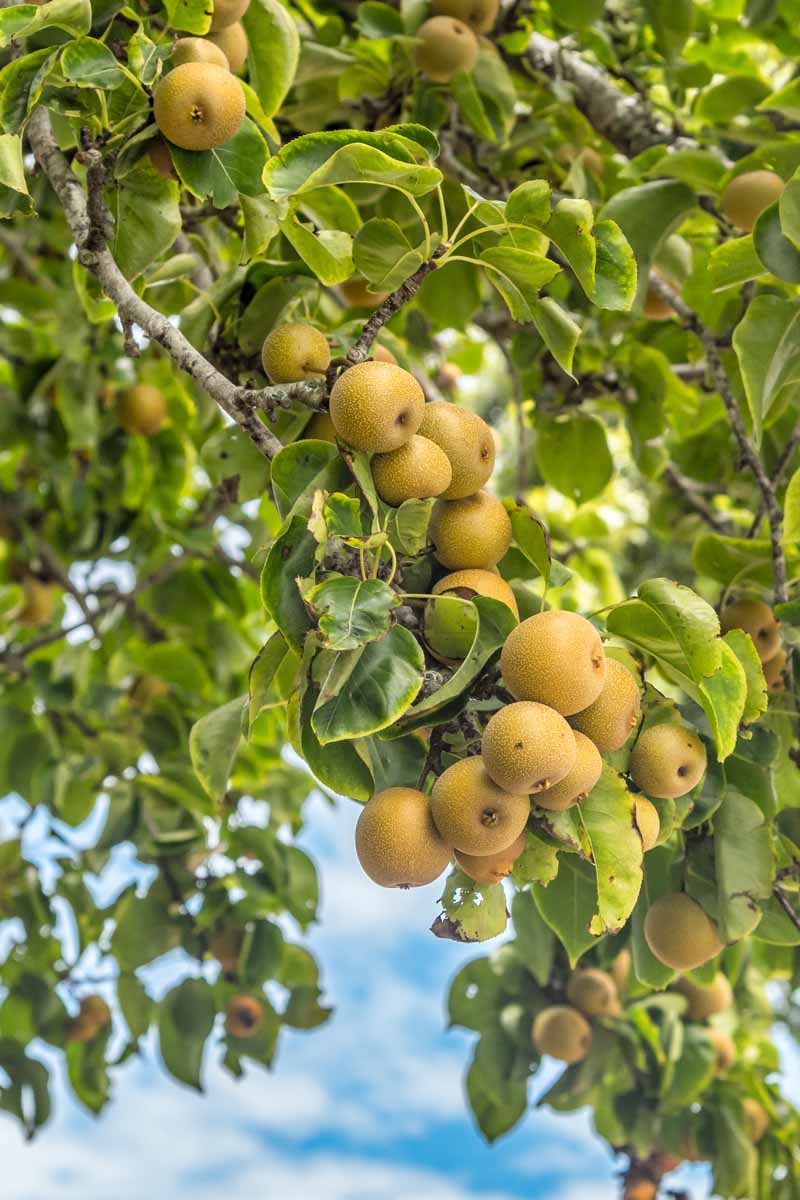
Despite some cultivars producing fruit evocative of an Malus pumila , the Asian pear isnota loan-blend with this fruit . Botanically , it is a true pear . I love it because I prefer unfluctuating and crisp variety show of this yield , and if that ’s your druthers , you will too .
For best results , you will need to plant two varieties that bloom at thesame prison term for pollenation . Some cultivars , such as ‘ Shinseiki , ’ ‘ 20th Century , ’ and ‘ Tennosui , ’ are self - pollinating .
Most other multifariousness ask cross - pollination . Even in the face of self - pollinating cultivars , grumpy - pollination leads to much bigger harvests .

Pairings that work well together for pollination purposes are :
Asian pears can also cross - pollinate with European pear . Asiatic miscellany ‘ twentieth Century , ’ for example , blooms at about the same time as ‘ Bartlett , ’ and ‘ Chojuro ’ blossom with ‘ Anjou . ’
Planting aP. pyrifoliaalongside a European smorgasbord can also advance more honeybees flock to both tree , as they ’re typically more pull to European mixed bag .

Cultivation and History
As their name implies , these fruits originated in easterly Asia and have beencultivated for at least 3,000 years . More specifically , they ’re aboriginal to western China , and long ago tame in south and central Japan .
Despite their long history in Asia , they ’re comparatively new in the United States , arrive here in 1820 when horticulturist William Prince import the industrial plant to grow in Flushing , New York .
Taiwanese miners and railroad workers planted seeds in California during the Gold Rush , and additional cultivars from Japan get with Japanese immigrant initiate in the 1890s .

China , Korea , and Japan are the main commercial exporters of the yield , but it ’s also mature in the United States in California , Oregon , and Washington , thanks to those other immigrants .
High in Vitamins C and K , and rich in fiber , the crisp fruit are often sliced and added to salads , broil into pies , and enjoy as snacks .
If you ’re wait for an exciting yield to grow at home that taste like a Pyrus communis but has the crunchy grain of an apple , seem no further thanP. pyrifolia .

Before you make your selections , check that you ’re in the right growing zone , and that you have tidy sum of space , and enough elbow room to plant two varieties .
Propagation
As with many other types of yield trees , P. pyrifoliaare most often propagated by being engraft onto rootstock of another variety . This is because come do n’t grow into exact replica of their parent trees .
Because grafting takes skill and especial equipment , the good manner to plant an Asiatic Pyrus communis tree is to buy two sort from a greenhouse or gardening fund and find a stark area to plant them together .
Other methods of propagation include micropropagation via tissue paper civilisation .

Some adventurous gardeners attempt to settle down new trees from cuttings , but this has a 30 - 90 per centum success charge per unit under the most idealistic conditions , in a professional nursery with controlled humidity and obnubilate hose .
Read more about pear propagation here .
How to Grow
If you ’re raise trees grafted onto dwarf rootstock – aka dwarf cultivar ofP. pyrifolia – you could found them in container . This is an fantabulous option for those with modified space .
Or , plant a dwarf or standard - sized cultivar directly into the reason for a beautiful and tasty addition to your landscape painting .
We ’ll compensate both planting methods to make it well-heeled for you to take which is best for your garden .

Planting in the Ground
The first thing you involve to do before you bring your tree home in the springtime or pass is to select the perfect location .
First , make certain you have enough place . The two trees will need to be institute about 15 understructure asunder if they ’re dwarf varieties , and 30 understructure aside if they ’re full - sized cultivars .
The grease should be moderately loose , organically rich , and well - debilitate with a pH between 6 and 7 . You canconduct a soil testto find out the pH and nutrient balance of your soil and meliorate accordingly .

The site should receive at least eight hours offull sunevery day in Zones 5 - 7 . If you live in Zones 8 or 9 , choose a site that receives partial afternoon shade to avail normalize the outcome of the heat .
When you ’re certain you have the perfect place for those saplings , localize your guild or play them home and dig holes for the roots . Each hole will postulate to be the same profoundness as the radical ball and twice as wide of the mark .
Place the root ball inside the golf hole and verify the crown of the tree diagram is level with the surface of the soil .

Backfill the hole with two portion native dirt and one part well - rotted compost or manure , and water deeply .
Keep the soil moist until your domain ’s first wintertime frost , particularly in the sapling ’s first few years of development . To check the moisture level , stick your finger about one column inch down into the filth . If it feels ironical , give the tree diagram a exhaustive lachrymation .
You do n’t have to water it through a halt , but verify to start checking the soil wet again as soon as the ground thaws in springtime .

Planting in a Container
It ’s easy to plant a dwarf tree in a container . Plus , it ’s skillful to have the selection to move it from one place to another , specially if you live in zone 8 or 9 , where you have to verify to keep your tree diagram coolheaded in the summertime . Container originate is also ideal for a terrace or small backyard .
The most important consideration here , of course , is the sizing of your container .
It should be at least 20 in in diameter . I love whiskey barrel container for develop midget fruit tree , likethis one from the Home Depotthat ’s 26 column inch in diam across the rim , 17.5 inches thick , and 21.5 inches wide at the base .

White Oak Wood Whiskey Barrel
This size of it will give a dwarf tree some human elbow way while making it ( relatively ) easy to move , most likely with help from a friend or by placing it on a cart with wheels .
Fill the container with gardening soil that ’s one part topsoil , one part well - decompose compost , and one part peat moss .

Vermont Organics Raised Bed Recharge
Or make the task easy by fill up it with premixed raise bed soil , like Vermont Organics Raised Bed Recharge availablefrom the Home Depot .
Make a hole in the filth that ’s as late as the root word ball and just a smidge wider . coif the root clump in spite of appearance and backfill with ground , making certain the tip of the sapling is level with the soil surface .

Water soundly and deep , and ensure the potful is set in an area that receives full sun and is within 15 foot of another multifariousness of Asiatic Pyrus communis .
you could add a three - inchlayer of dark mulchto help keep the tree warmduring the winter , and a light bed to assist it keep cool during the summer .
Use constitutive mulch such as straw or wood chips so that the material can add nutrient to the grime as it rot . Replace it each time of year to keep that bed of protection over the tree diagram ’s theme organization .

Growing Tips
Pruning and Maintenance
During the first year of growth after planting , you ’ll want towater your Asian pear treeonce or twice a week , depending on the amount of rainfall .
Give it a thorough soaking at the base , and allow the top inch of soil ironic out before you water again .
Once the tree is establish , you’re able to irrigate it once a week , or when the top two to three inch of soil wry out .

Every time you water , check for weeds . You do n’t desire any weeds or grass growing over the radical system and contend for water and nutrients .
To retain moisture and suppress weeds , consider putting down a three - inch layer of mulch . In affectionate country , use a light - colored mulch to help keep the roots coolheaded .
As for fertilizing , you only need to ensure the tree invite fertiliser once a year : as soon as the soil is workable in the spring .

Simply add a balanced 10 - 10 - 10 ( NPK ) plant food to give the plant a rise .
To keep the tree diagram hefty , prune away morbid , broken in , or wound branches during its winter dormancy stop .
you may also prune the tops of the branches furthest away from the trunk , as those produce fruit that ’s less sweet and often small . This will also assist to keep the height accomplishable .

In addition , lop some of the branches nearest to the trunk to promote them to bring out bloom . To do this , utilise pruning shears and trim back the ramification about two or three buds off from the main branch .
In all , you should pruneabout 10 per centum of the tree ’s total arm each winter .
If you are growing your Asiatic pear in a container , you ’ll want to crop it to remain about five to six foot tall – basically turning it into a fruit - suffer bush rather than a full dwarf - sized yield tree . You ’ll still get a seemly harvest , but your tree will remain a manageable size .

Once the Sir Herbert Beerbohm Tree flush and start fruiting in the outflow , thin the fruits to one pear every four to six column inch on any given offshoot .
This helps the single yield grow bragging and reduces pest and disease infestation since the infinite provides the yield with adequate public discussion .
Cultivars to Select
Peruse our three favorite cultivar of this tasty fruit :
Chojuro
dead on target to its name , which interpret to “ plentiful ” in Japanese , ‘ Chojuro ’ produces ample fruit , often in its very first year after establish .
With its round apple shape and gamy - sweet butterscotch feeling , this smorgasbord is the one most commonly detect in grocery stores ( when you could see them ! ) .
‘ Chojuro ’

But you could have it in your own backyard , too . ‘ Chojuro ’ is a dwarf cultivar that grows to a mature height of eight to 10 feet with a spread of six to eight feet .
Easily pollenate by planting ‘ Hosui ’ alongside it , ‘ Chojuro ’ require 450 chill hour .
you could regain treesavailable from Nature Hills Nursery .

Hosui
Are you quick to dive headfirst into the world of growingP. pyrifolia ? Then ‘ Hosui , ’ with its 10- to 20 - base superlative and disseminate and classic , russet , apple - influence fruits , is the perfect cultivar for you .
In Japanese , ‘ Hosui ’ think of “ abundant juice ” or “ much water , ” depending on the displacement . You get the idea : this is a turgid , extra - juicy cultivar .
With 300 - 400 iciness hours required each wintertime at 45 ° F or below , this is the perfect Sir Herbert Beerbohm Tree for those in cooler climes .

Although it grows well in warmer locations , keep in mind you wo n’t get a in force harvesting with fewer than 300 shivering hours .
‘ Hosui ’
This cultivar often begins producing yield in its second year , though it can take up six years before you could foot a adequate harvest time . Fruit tend to mature in early August .

It ’s also a self - pollinating change , although you ’ll only get a small harvest without establish another variety nearby with a alike bloom time for cross - pollenation .
you’re able to find bare antecedent ‘ Hosui ’ treesavailable at Burpee .
If you favor a dwarf ‘ Hosui , ’ which reach up to 12 foot in height , you’re able to bump itat the Home Depot .

Shinseiki
‘ Shinseiki , ’ which translate to “ new century , ” is a cross between two democratic varieties : ‘ 20th Century ’ and ‘ Chojuro . ’ When ripe – unremarkably sometime in August – this mid - sizing fruit is promising chickenhearted and exceedingly crunchy .
With a modest spirit and coarse grain , this is the fruit for those of us who love steadfast pears with a hint of rose flavor .
‘ Shinseiki ’
‘ Shinseiki ’ extend to a height of 12 feet and only requires 250 - 300 thrill hour .
Container trees are available at Nature Hills Nursery .
20th Century
‘ twentieth Century , ’ aka ‘ Nijisseiki , ’ is highly pop for its teemingness of incredibly juicy fruit and cosmetic , multi - time of year interest .
The attractive mid - sized yield is bright sensationalistic with a hint of rosy blush , and it has a crisp texture and balmy savour . A just steward , fruits store well for up to five months in cold storage at 31 ° degree Fahrenheit .
‘ 20th Century ’
Before the leafage appear , branches are insure in clusters of showy white blossom . Fruit is quick to harvest bulge in other August , and in fall , the shining green leaves turn a vivacious orangey red .
Trees reach mature proportion of 12 to 18 - feet - tall with a spread of 12 to 15 feet .
‘ twentieth Century ’ requires 400 thrill hours at temperatures below 45 ° farad . Although it is ego - prolific , this type delivers a larger harvest when planted in tightlipped law of proximity to another cultivar that bloom at the same fourth dimension .
Container trees areavailable at Nature Hills Nursery .
need More pick ?
Be indisputable to check out our supplemental guide , “ 9 of the Best Asiatic Pear Varieties for the Home Garden ” to find the best choice for your soil and clime .
Managing Pests and Disease
WhileP. pyrifoliadon’t fall prey totoomany pests or diseases , there are a few major bad hat to watch out for .
Herbivores
If you have deer or moose in your area , it ’s time to check how to keep the prominent herbivore away from your precious Asian pear trees .
Cervids , whether they ’re moose or cervid , wo n’t waver to devour your tree whether it ’s got yield on it or not .
commit me , I learned this the hard way .
But I also get wind how to keep the pestilence out of my apple woodlet , which you’re able to hear more about in ourguide to keeping moose out of your cubic yard .
Plantskydd
You ’ll either have to trust on a atomiser - covering repellant like Plantskydd , whichyou can find on Amazon , or you ’ll have to build up a fencing , which the clause above shows you how to do .
I do both . I do n’t take any chances with deer .
Insects
There are two major plant pests to watch for when you ’re growing Asian pear tree .
The first is the codling moth ( Carpocapsa pomonella ) , which eats through the fruit to get at the seeds , yield it inedible . Codling moth lay tiny semitransparent ball on the leaves . The larvae have black heads and white bodies .
If you happen to blob ballock or larvae before they do too much damage , you’re able to try free moth egg parasite ( Trichogrammaspp.),available from Arbico Organics , according to package instructions .
BONIDE ® All Seasons Horticultural Spray Oil
you may also spray horticultural oil , availablefrom Arbico Organics , on the leaf and trunk to repress unhatched eggs .
Another way to prevent infestation is to space the fruits far enough aside so they are n’t poignant , reduce them to one pear every four to six inches on any given branch .
The twospotted spider mite , Tetranychus urticae , is a tiny brownish - green pest that causes damage to leafage and usually only bothers a tree if it is water - stressed .
preserve your sapling well - watered can help forbid plague , as can a rotation of miticides likeBonide Insecticidal Soap , Bonide Mite - X , andOrganocide Bee Safe Garden Spray , all available from Arbico Organics .
Diseases
There ’s one major disease that threatens the health of yourP. pyrifoliaplants . Below , you ’ll find out what it is and how to handle it .
By far the most dreadful disease an Asian Pyrus communis tree can face , fire blight , triggered by the bacteriaErwinia amylovora , destroys any existing fruit and turns leave-taking to a burnt - crisp color and texture , hence the name .
It spreads easily and can stamp out entire trees . Early discussion is all-important to the recovery of a plant .
If you comment the telltale shriveled leave , polish off the entire affected branch at least 12 inches below the first infected leaf . Take it far away to be burned or dispose of it in the trash .
Dip your shear or pruners in a result of water and 10 percentage bleach to help prevent the spread of the infection .
BONIDE ® Liquid Copper Fungicide
All Asiatic pear trees except ‘ Shinko ’ are susceptible to fire blight , but you could help prevent it by apply liquified atomic number 29 , like BONIDE ® Liquid Copper Fungicidefrom Arbico Organics , to the top of each bud when it breaks in the springtime .
Reapply the solution every four to five sidereal day until the blossom shrivels and the fruit begin to grow .
Harvesting
Fruits may be harvested any prison term between August and October , count on the cultivar you ’re grow .
Asiatic pear ripen on the tree , so when the fruit is the size , color , and firmness it ’s supposed to be at maturity , it ’s quick for clean .
If you think it ’s almost picking sentence but you ’re not trusted , take one pear off the tree and prick into it . Does it taste like a toothsome , nippy , juicy pear ? If so , then it ’s harvest time !
To harvest , gently grasp the fruit , rustle it , and twist it off the branch . throng your bounteousness in a padded bucketful until you decide what to do with them , as they bruise very easy .
you could take more about how to reap pear in our guide .
Preserving
The good way to uphold them to eat on whole ? station them in the chiller compartment of your refrigerator . They ’ll keep that resistless terse grain and savour .
I doubt they ’ll even last you three months , they ’re so delicious .
you may learn to store pears in our guide .
you’re able to also dry slices in the oven . pop by washing each yield , disrobe the hide off ( if you need to ) , and core it . Cut into fade that are 1/2 an inch fatheaded .
Lay the slices on a grease biscuit flat solid . station the sail in an oven stir up to just 175 ° F and make for about four hours , flip out the slices over every hour , until they have a leathery grain .
Once they ’ve whole cool down off , put in them in a tin cooky container and love ! They ’ll last between six months and one class in a cool , dry localisation .
If you ’d rather freeze out your pear tree to puree after for smoothie or baking , you’re able to do that too . uncase them , core them , and slice up them into halves or into lowly pieces .
Lay the piece on a cookie sheet and put them into the freezer for four hour or until they ’re frozen solid . Transfer them to a deep-freeze bag , and voila ! Just commend to exhaust them within six month .
Recipes and Cooking Ideas
In my vox populi , the good way to corrode an Asian pear tree is fresh off the tree . But I adore eating them in salads , too , like this pear tree , currant , and hazelnut saladfrom our baby site , Foodal .
The recipe calls for ‘ Bosc ’ pears , which you’re able to easily step in with slicedP. pyrifolia .
If you have a gratifying tooth , you could also use some of your crop to make this heavenly pear sorbet with ginger - infused maple sirup , also from Foodal .
Quick Reference Growing Guide
A Peary Happy Harvest
I woolgather of traveling to Japan and China someday , to sample their expertly grownP. pyrifoliafruits . If you ’ve ever had this experience , consider me jealous , but in a estimable way .
And for more information aboutgrowing pear trees , stop out these guide next :
exposure by Nikki Cervone © inquire the Experts , LLC . ALL right wing RESERVED.See our TOSfor more details . in the beginning published October 26th , 2020 . Last updated September 10th , 2023 . Product exposure via Arbico Organics , Burpee , Home Depot , Nature Hills Nursery , and Plantskydd . Uncredited photos : Shutterstock .
About
Laura Ojeda Melchor
